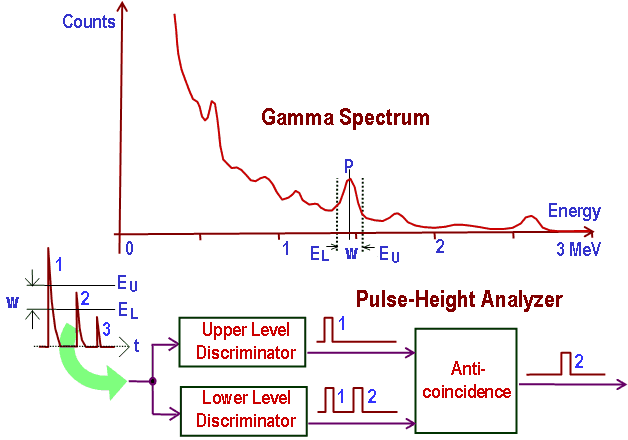
Gamma spectroscopy is a vital technique for identifying and quantifying gamma radiation from radioactive sources. It is widely used in applications ranging from environmental monitoring and nuclear medicine to security and nuclear power. The performance of gamma spectroscopy systems depends largely on the type of radiation detector used, with
CZT (Cadmium Zinc Telluride) detectors and
scintillator detectors being the two primary technologies used for gamma detection.
This article delves into a detailed comparison of
CZT detectors and
scintillator-based detectors for gamma spectroscopy, examining their
performance,
advantages,
limitations, and
suitability for different applications. We will explore various aspects such as
energy resolution,
detection efficiency,
cost, and
system complexity to determine which detector technology offers better performance in gamma spectroscopy.
## 1. Overview of Gamma Spectroscopy
Gamma spectroscopy involves measuring the energy and intensity of gamma radiation emitted from a radioactive source. By analyzing the energy spectrum of the detected radiation, it is possible to identify the isotopes present in the sample and quantify the amount of radioactive material. The performance of gamma spectroscopy systems relies heavily on the detector’s ability to resolve and measure the energy of incoming gamma photons with high accuracy.
Key requirements for gamma spectroscopy detectors include:
*
Energy Resolution: The ability to distinguish between closely spaced gamma energy peaks.
*
Detection Efficiency: The proportion of gamma photons that the detector can successfully capture and measure.
*
Linear Response: The ability to provide consistent and predictable responses over a range of gamma energies.
*
Spectral Stability: The ability to maintain accurate performance over time, with minimal drift or degradation.
*
Cost-effectiveness: The overall expense of the detector and associated electronics, especially for large-scale or portable applications.
## 2. CZT Detectors in Gamma Spectroscopy
CZT detectors are semiconductor detectors made from
Cadmium Zinc Telluride (CZT), a direct-bandgap material that can efficiently convert the energy of gamma photons into measurable electrical signals. These detectors have seen increasing adoption in various gamma spectroscopy applications due to their unique properties.
## Advantages of CZT Detectors in Gamma Spectroscopy
*
High Energy Resolution: One of the standout features of
CZT detectors is their
exceptionally high energy resolution. CZT detectors can resolve energy peaks with greater precision than many scintillator-based systems, making them particularly valuable for applications requiring accurate isotopic identification. The high energy resolution enables these detectors to differentiate between
closely spaced gamma peaks, improving the accuracy of spectral analysis. This is essential for identifying multiple isotopes in complex samples, such as environmental or industrial monitoring.
*
Direct Conversion of Gamma Rays:
CZT detectors directly convert the energy of
gamma photons into an electrical signal without the need for intermediate steps (such as light emission in scintillators). This direct conversion process leads to
fewer energy losses and
more accurate measurements, especially for high-energy gamma photons. This feature is beneficial for applications in which high gamma energy resolution is required.
*
Compact and Solid-State Design:
CZT detectors are compact and
solid-state, meaning they do not require any external components like photomultiplier tubes (PMTs) or scintillator crystals. This makes them more durable and less prone to mechanical failure compared to other detector types. Their small size also makes them ideal for portable gamma spectroscopy devices, which are widely used in field applications for radiation detection and environmental monitoring.
*
No Need for External Cooling: While some semiconductor detectors require cooling systems (like
HPGe (High-Purity Germanium) detectors),
CZT detectors typically function at room temperature, eliminating the need for cryogenic cooling. This makes them more practical for field operations and portable gamma spectroscopy systems, where the complexity and cost of cooling systems are a concern.
## Challenges and Limitations of CZT Detectors
*
Cost: The main drawback of
CZT detectors is their
relatively high cost. The material itself is expensive to produce, and the fabrication process can be complex. This can make
CZT detectors less affordable compared to scintillator-based systems, particularly in applications where a large number of detectors are needed, such as in large-scale environmental surveys or industrial monitoring.
*
Material Quality and Manufacturing Variability: The performance of
CZT detectors can be affected by variations in the
quality of the CZT crystal. The material properties of CZT are not always uniform, which can lead to variations in the energy resolution and efficiency of detectors. This means that detectors need to be carefully calibrated to ensure consistent performance across different devices.
*
Temperature Sensitivity: While
CZT detectors do not require active cooling, they can still be sensitive to
temperature variations, which can affect their
energy resolution and
response time. In environments with significant temperature fluctuations, the performance of
CZT detectors may degrade unless additional temperature stabilization is provided.
## 3. Scintillator Detectors in Gamma Spectroscopy
Scintillator detectors use a scintillating material, such as
NaI(Tl) (sodium iodide doped with thallium) or
CsI(Tl) (cesium iodide doped with thallium), which emits light when struck by gamma radiation. This emitted light is then detected by a
photomultiplier tube (PMT) or a
photodiode. Scintillator-based systems have been widely used for gamma spectroscopy due to their
simplicity,
reliability, and
cost-effectiveness.
## Advantages of Scintillator Detectors in Gamma Spectroscopy
*
Cost-Effectiveness:
Scintillator detectors are generally much more
affordable than
CZT detectors. The scintillator crystals are less expensive to produce, and the systems are simpler to manufacture. This makes them a more viable option for large-scale gamma spectroscopy systems where budget constraints are a concern.
*
High Count Rate Capability:
Scintillator detectors typically have excellent
count rate capabilities, meaning they can detect a large number of gamma photons in a short period of time. This makes them well-suited for applications requiring fast or high-throughput measurements, such as
industrial radiation surveys or
monitoring of high-intensity radiation fields.
*
Durability and Robustness:
Scintillator detectors are known for their
robustness. They are less sensitive to mechanical shock and environmental factors like humidity or vibration compared to semiconductor detectors. This makes them ideal for use in
harsh environments, such as industrial settings, where durability and reliability are key.
*
No Need for Semiconductor Processing: Unlike
CZT detectors,
scintillator-based detectors do not require complex semiconductor processing, which makes them easier to manufacture and maintain.
## Challenges and Limitations of Scintillator Detectors
*
Lower Energy Resolution: One of the major limitations of
scintillator detectors is their
lower energy resolution compared to
CZT detectors. While they are adequate for many applications, they may struggle to resolve closely spaced gamma energy peaks, which is critical in applications requiring high precision, such as
environmental radiation monitoring and
isotopic identification in complex samples.
*
Light Loss and Scattering: The process of
light emission in scintillators involves several steps before the light is converted into an electrical signal. This can lead to
light loss or
scattering, which reduces the overall efficiency and accuracy of the detector. In particular, large scintillator crystals can suffer from
signal degradation, which can impact the quality of the gamma spectrum.
*
Temperature Sensitivity: While less sensitive than
CZT detectors,
scintillator detectors can still exhibit some
temperature dependence, particularly in high-temperature environments. This can affect their
energy resolution and
efficiency.
## 4. Comparing CZT and Scintillator Detectors for Gamma Spectroscopy
Here is a detailed comparison of
CZT detectors and
scintillator detectors in the context of
gamma spectroscopy:
|
Performance Factor |
CZT Detectors |
Scintillator Detectors |
| --------------------------- | ------------------------------------------------------------------------------ | -------------------------------------------------------------------- |
|
Energy Resolution | High, ideal for precise isotopic identification | Lower, less effective for distinguishing close energy peaks |
|
Detection Efficiency | High, direct conversion of gamma photons to electrical signals | Moderate, some light loss and scattering |
|
Cost | High, due to material and manufacturing complexity | Low, cost-effective for large-scale use |
|
Temperature Sensitivity | Sensitive, can affect performance in extreme conditions | Less sensitive, but can still be impacted |
|
Durability | Less durable, may be more susceptible to damage | More durable and robust in harsh environments |
|
Speed | Moderate, slower than scintillators | High, fast response for real-time measurements |
|
Applications | Ideal for precise gamma spectroscopy in research, security, and medical fields | Suitable for large-scale monitoring and high-count rate applications |
## 5. Conclusion
In
gamma spectroscopy, the choice between
CZT detectors and
scintillator detectors depends largely on the
specific requirements of the application.
*
CZT detectors offer
superior energy resolution, making them ideal for applications where precise identification of gamma isotopes and fine spectral analysis is required. They are well-suited for
environmental monitoring,
nuclear medicine, and
security applications where accurate isotopic analysis is critical.
*
Scintillator detectors, on the other hand, are more
cost-effective,
durable, and
efficient for high-throughput measurements. They are widely used for
routine monitoring,
industrial applications, and
high-count rate scenarios where the
precise energy resolution of
CZT detectors is not a critical requirement.
Ultimately, the choice between these two technologies should be based on a
trade-off between
energy resolution,
cost,
detection efficiency, and the specific application needs. For high-precision spectroscopy,
CZT detectors are the better option, while
scintillators are more suited for general-purpose or large-scale radiation detection systems.
CdZnTe Association (CdZnTe.com)
https://www.cdznte.com/blog/czt-vs-scintillators-for-gamma-spectroscopy-which-offers-better-performance.html



