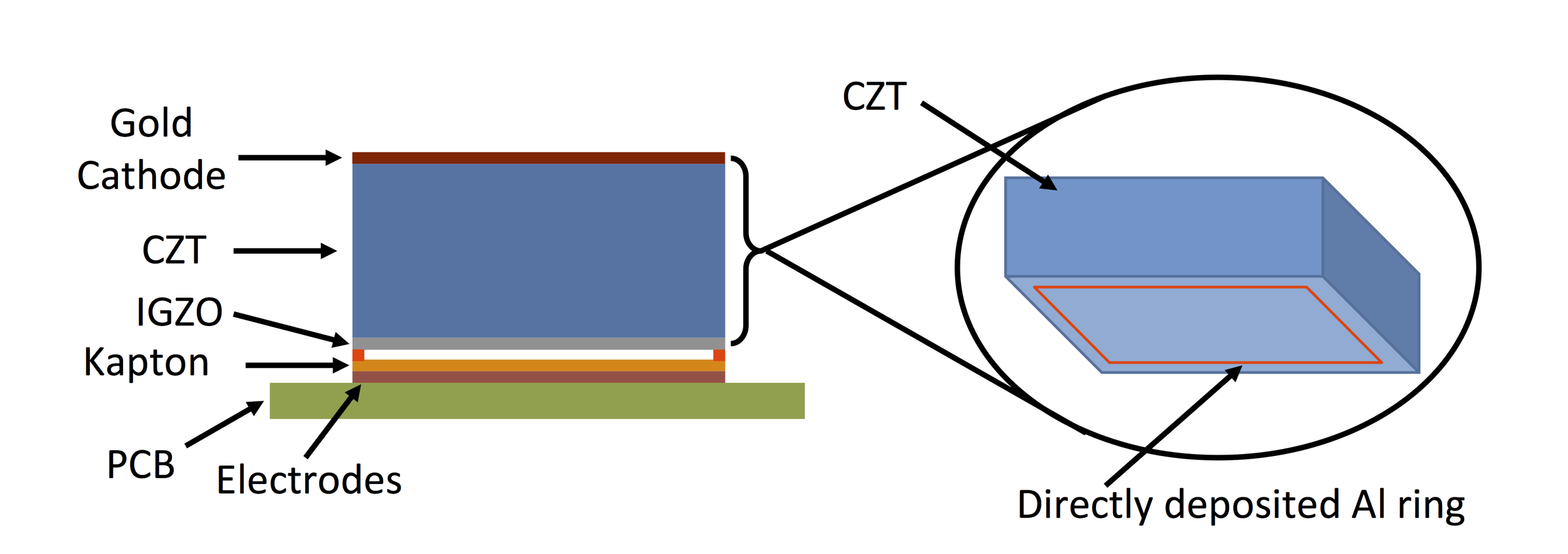
The role of
electrical contacts in the performance of
CZT-based radiation detectors is critical because they directly influence key performance characteristics, such as charge collection efficiency, signal integrity, energy resolution, and overall detector reliability. Since
Cadmium Zinc Telluride (CZT) is a
semiconductor material, the electrical contacts serve as the interface between the detector and the external circuitry, ensuring proper signal extraction from the detector. The quality, material choice, and design of these contacts can significantly impact the detector’s ability to accurately detect radiation and maintain consistent performance over time.
## 1. Charge Collection and Signal Generation
When
ionizing radiation (such as X-rays or gamma rays) interacts with the CZT crystal, it generates
electron-hole pairs. To detect these generated charge carriers, an
electric field is applied across the CZT crystal, typically via the electrical contacts. The role of the contacts in this process is to:
*
Extract Charges: The electrical contacts allow for the extraction of the
electron and
hole charges generated by radiation interaction within the CZT crystal. These carriers move in opposite directions under the influence of the applied electric field (usually supplied via the contacts).
*
Charge Collection Efficiency: The efficiency with which the charges are collected is greatly influenced by the
quality of the electrical contacts. Any defects, such as
poor contact formation or
high contact resistance, can lead to a
loss of charge carriers before they are collected, reducing the
charge collection efficiency and ultimately degrading the detector's performance.
## 2. Ohmic and Schottky Contacts
In CZT detectors, there are typically two types of electrical contacts used:
*
Ohmic Contacts: These contacts are designed to have minimal resistance to current flow. They are usually made of metals with a
low work function that form a
good electrical connection to the semiconductor. The role of the ohmic contact is to allow for the efficient extraction of charge carriers without introducing significant resistance or altering the electric field within the CZT crystal.
*
Schottky Contacts: A
Schottky contact is a
metal-semiconductor junction that can form a
barrier to charge flow, which may influence the electric field profile within the CZT crystal. Schottky contacts are often used in applications where specific
charge transport properties are required, but they may lead to
non-linearities or introduce a
reverse bias leakage current.
The choice of whether to use
ohmic or Schottky contacts depends on the specific application and the desired performance characteristics.
Ohmic contacts are generally preferred for
high-efficiency charge extraction, as they minimize the risk of
polarization or charge trapping.
## 3. Contact Resistance and Its Effects
The
contact resistance at the interface between the CZT material and the electrode is a critical factor that affects the overall
signal generation and
charge collection process. High contact resistance can have several negative effects on the performance of CZT-based detectors:
*
Decreased Charge Collection Efficiency: High contact resistance can cause
voltage drops across the interface, which can reduce the
electric field at the electrodes. This weakens the charge collection process and reduces the
sensitivity and
energy resolution of the detector.
*
Increased Leakage Currents: Poor electrical contact can increase the likelihood of
leakage currents that bypass the primary charge collection path, further reducing the
signal-to-noise ratio (SNR) and the detector's overall performance. These leakage currents can also contribute to
polarization effects, where the detector's response degrades over time under continuous irradiation.
*
Distortion of Electric Field: If the contact resistance is not uniform or if the contact itself is improperly designed (e.g., non-linear contacts), it can distort the
electric field within the CZT crystal. This can lead to
non-ideal charge collection, increased
electron-hole recombination, and
spatially varying charge carrier drift velocities, all of which degrade detector performance.
## 4. Contact Material Choice
The material used for the electrical contacts is essential in determining the overall effectiveness of the detector. The materials must meet several key requirements, such as high electrical conductivity, good mechanical stability, and compatibility with the CZT crystal.
## 4.1 Metal Contacts
Common metals used for electrical contacts in CZT-based detectors include
gold (Au),
silver (Ag), and
nickel (Ni). Each of these materials has different properties that make them suitable for different applications:
*
Gold (Au): Gold is commonly used because of its
high electrical conductivity,
chemical stability, and
low contact resistance to semiconductors. Gold contacts are often used for
high-performance detectors because they minimize issues with leakage current and charge loss.
*
Silver (Ag): Silver has even better conductivity than gold but is more prone to oxidation and corrosion. Silver contacts can provide excellent
charge collection efficiency but may degrade over time due to environmental factors.
*
Nickel (Ni): Nickel is more commonly used in the form of
nickel-chromium alloys for their mechanical robustness and
compatibility with CZT crystals. Nickel can form good
ohmic contacts with CZT and can also be used in combination with other metals to improve
adhesion and
long-term stability.
## 4.2 Ohmic Contact Materials and Interface Engineering
The efficiency of the electrical contact depends on the
interfacial properties between the metal and the CZT crystal. To form a reliable ohmic contact, the contact material must be properly
bonded to the CZT, typically through a process like
sputtering,
evaporation, or
electroplating. These processes ensure that the contact area has
minimal resistance and does not introduce defects at the interface. If the interface is not engineered correctly,
Schottky-like behavior can arise, leading to significant
non-idealities in the detector's operation.
## 5. Surface Preparation and Contact Formation
Before attaching the electrical contacts, proper
surface preparation of the CZT crystal is essential to ensure effective contact formation. The surface of the crystal should be:
*
Cleaned: The CZT surface must be free from contamination, such as oils or oxides, which can lead to poor adhesion and
high contact resistance.
*
Polished: The crystal surface must be smooth and free from defects to form a uniform and reliable contact. Mechanical or chemical polishing processes are often used to ensure that the surface is flat and free from roughness, which could interfere with charge collection.
*
Passivated: The surface may also need to be
passivated with a thin layer of material to reduce the number of surface states that could trap charge carriers and degrade performance.
## 6. Electrode Design and Geometry
The
geometry and design of the electrodes also play a critical role in the performance of CZT-based radiation detectors. The following considerations are essential:
*
Electrode Size and Shape: The electrodes must be designed to efficiently collect charge from the entire detection volume of the CZT crystal. For example, if the electrodes are too small or poorly positioned, they may not collect charge from all regions of the crystal, leading to
non-uniform charge collection and decreased detector efficiency.
*
Electrode Placement: The placement of the contacts must be optimized to ensure a
uniform electric field across the detector and to avoid
localized field distortions that could lead to charge trapping and polarization effects.
*
Indium Bonding or Wire Bonding: In some cases,
indium bump bonding or
wire bonding techniques are used to attach the contacts to the CZT crystal. The bonding must be carefully engineered to avoid mechanical stress, which could lead to cracking or defects in the crystal that degrade performance.
## 7. Thermal Management
Thermal effects on the contacts are another critical consideration. High
contact resistance and
thermal expansion mismatches between the CZT crystal and the electrodes can lead to
mechanical stresses, which could damage the crystal or the contact interface. The
thermal conductivity of the contact material should be compatible with the CZT's thermal properties to ensure stable performance under varying environmental conditions.
## 8. Stability and Long-Term Performance
Over time, the
stability of the electrical contacts is important to maintain consistent detector performance. The contacts should be designed to withstand
radiation-induced damage,
corrosion, or
oxidation, all of which can alter the contact's resistance and the detector’s overall performance. Regular testing and quality control during manufacturing help ensure the durability of the electrical contacts, which are crucial for long-term, reliable operation of the CZT detector.
## 9. Conclusion
In summary, the
electrical contacts in CZT-based radiation detectors are vital for efficient charge collection, signal integrity, and overall detector performance. Proper selection of materials, contact resistance management, electrode design, and surface preparation are essential for ensuring optimal detector function. The electrical contacts directly affect the charge collection efficiency, energy resolution, leakage currents, and long-term stability of the detector, which are all critical to the overall performance in radiation detection applications. Therefore, careful engineering of the electrical contacts is necessary to fully realize the potential of CZT as a high-performance radiation detector material.
CdZnTe Association (CdZnTe.com)
https://www.cdznte.com/blog/what-is-the-role-of-the-electrical-contacts-in-the-performance-of-czt-based-radiation-detectors.html



