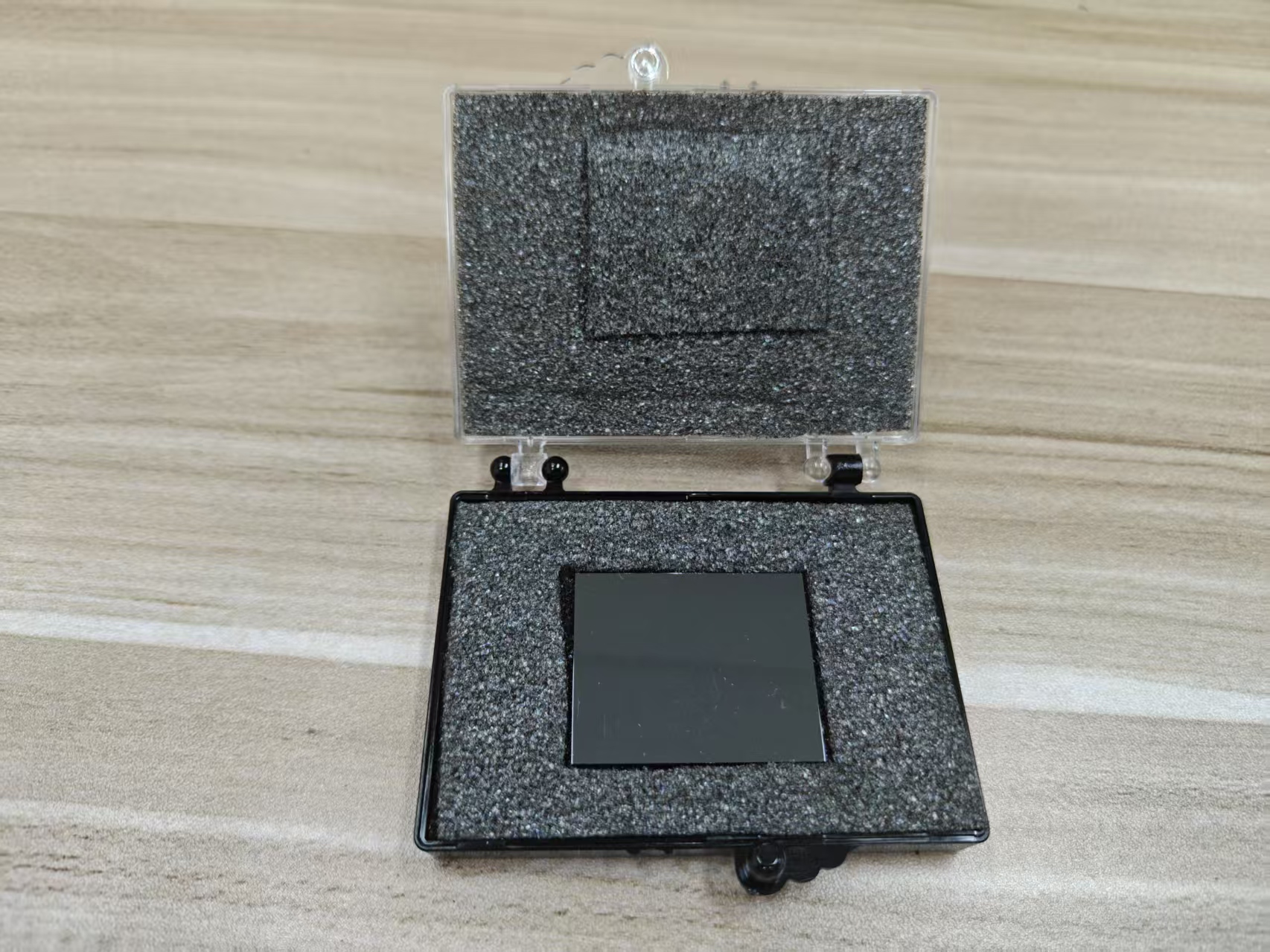
The energy resolution of cadmium zinc telluride (CZT) crystal detectors, especially those with thick geometries (typically ≥5 mm), is fundamentally limited by several interdependent physical, material, and device-level factors. While thick CZT detectors are necessary for high-efficiency detection of high-energy gamma rays (e.g., >300 keV), increasing the crystal thickness introduces new challenges that degrade spectral performance. The following outlines the primary technical limitations on energy resolution in thick CZT detectors.
## Charge Carrier Trapping and Transport Nonuniformity
CZT detectors rely on the collection of charge carriers (primarily electrons) generated by the absorption of incident radiation. In thick detectors, the distance electrons must travel to the anode is longer, increasing the likelihood of carrier trapping.
* Electron Trapping: Even though electrons in CZT have higher mobility-lifetime (μτ) products than holes, imperfections in the lattice such as Te inclusions, dislocations, and point defects trap electrons. The longer the drift path, the more trapping occurs, degrading the pulse amplitude and energy resolution.
* Depth-Dependent Signal Loss: In a thick detector, energy deposited deeper in the crystal results in carriers that travel further, introducing depth-dependent signal amplitude variations. This leads to pulse height broadening and worsened energy resolution.
* Nonuniform μeτe Distribution: Variations in electron transport properties across the crystal (laterally and in depth) further contribute to signal dispersion, especially in large-volume devices.
## Hole Contribution and Poor Hole Transport
CZT has intrinsically poor hole transport due to low hole mobility (~50 cm²/V·s) and short lifetime (~10⁻⁷ s). In thick detectors, holes generated far from the anode often do not reach the electrode, leading to incomplete charge collection.
* Tail Effects: The slow or incomplete collection of holes causes asymmetric broadening of photopeaks (low-energy tailing), particularly in planar electrode configurations.
* Uncompensated Charge: Hole trapping leaves behind space charge, which can distort the internal electric field over time, further degrading resolution.
## Increased Influence of Defects and Inclusions
The probability of encountering material imperfections increases with detector volume. These imperfections severely affect charge transport and collection.
* Te Inclusions: Tellurium inclusions are the most common native defect in CZT. They act as strong trapping centers and introduce local field distortions.
* Grain Boundaries and Dislocations: Multigrain structures or high dislocation density disrupt carrier flow, leading to localized charge loss or field screening effects.
* Segregation Zones: Variations in Cd/Zn composition across the boule create inhomogeneous bandgap and trap distributions.
## Electric Field Nonuniformity
Maintaining a uniform electric field across a thick detector is difficult due to space-charge buildup, crystal resistivity variations, and non-ideal contact behavior.
* Space-Charge Effects: Trapped carriers accumulate over time, especially under continuous bias, leading to polarization. This distorts the electric field, reducing collection efficiency nonuniformly across the depth.
* Bias Limitations: Higher voltages are needed to maintain sufficient drift velocity over thick regions, but CZT has a relatively low breakdown field (~10⁴ V/cm). Increasing thickness without proportionally increasing bias weakens field strength.
## Electronic Noise and Capacitance Effects
As detector thickness increases, so does the detector capacitance, especially in large-area or pixelated designs. This contributes to higher electronic noise, which impacts energy resolution.
* Capacitive Noise: Higher capacitance increases voltage noise in the front-end electronics. This becomes a dominant factor when the signal-to-noise ratio is low, as in low-energy gamma-ray detection with thick detectors.
* Inter-Pixel Crosstalk: In pixelated thick detectors, increased volume leads to more significant charge sharing and crosstalk between neighboring pixels, blurring spectral lines and reducing effective resolution.
## Depth of Interaction (DOI) Dependence and Signal Correction Complexity
In thick detectors, events occurring at different depths produce varying signal amplitudes due to differential charge collection times. Without correcting for this depth of interaction, energy resolution suffers.
* DOI Correction Requirements: Advanced readout schemes (e.g., using cathode-to-anode signal ratios, drift time measurements, or 3D position-sensitive electronics) are required to compensate for depth-dependent effects. These introduce complexity and calibration challenges.
* Temporal Dispersion: Variations in drift time broaden signal rise times, increasing ballistic deficit and signal undershoot in shaping amplifiers, both of which degrade resolution.
## Temperature Effects and Thermal Gradients
Thicker detectors are more susceptible to internal thermal gradients during operation, which can influence charge transport and defect activity.
* Carrier Mobility Variation: Localized heating can reduce carrier mobility and lifetime, introducing position-dependent transport nonuniformity.
* Trap Activation: Higher temperatures may thermally activate traps, increasing leakage current and electronic noise, both of which reduce resolution.
## Gamma-Ray Interaction Mechanisms
At higher energies and in thick detectors, the probability of multiple interaction processes (e.g., Compton scattering, photoelectric absorption) increases within the same crystal.
* Multiple Scattering Events: A single gamma photon may undergo Compton scattering followed by photoelectric absorption at a different location, generating a complex charge cloud. Unless the readout can distinguish and localize both events, partial energy deposition may be misrecorded.
* Partial Energy Loss: If secondary interactions occur near crystal boundaries or defects, charge may be lost, producing spectral artifacts or continuum tails.
## Conclusion
The achievable energy resolution in thick CZT crystal detectors is limited by a combination of fundamental material properties (e.g., carrier mobility-lifetime, defects), device design constraints (e.g., electrode geometry, bias uniformity), and practical system-level factors (e.g., electronic noise, DOI correction). While thickness improves quantum efficiency for high-energy photons, it simultaneously amplifies the impact of charge transport nonuniformity, trapping, and field distortion. Addressing these challenges requires high-purity crystal growth, defect engineering, optimal contact design, sophisticated readout electronics, and DOI-aware signal processing to approach the theoretical limits of resolution in thick CZT detectors.
CdZnTe Association (CdZnTe.com)
https://www.cdznte.com/blog/what-limits-the-achievable-energy-resolution-in-thick-czt-crystal-detectors.html