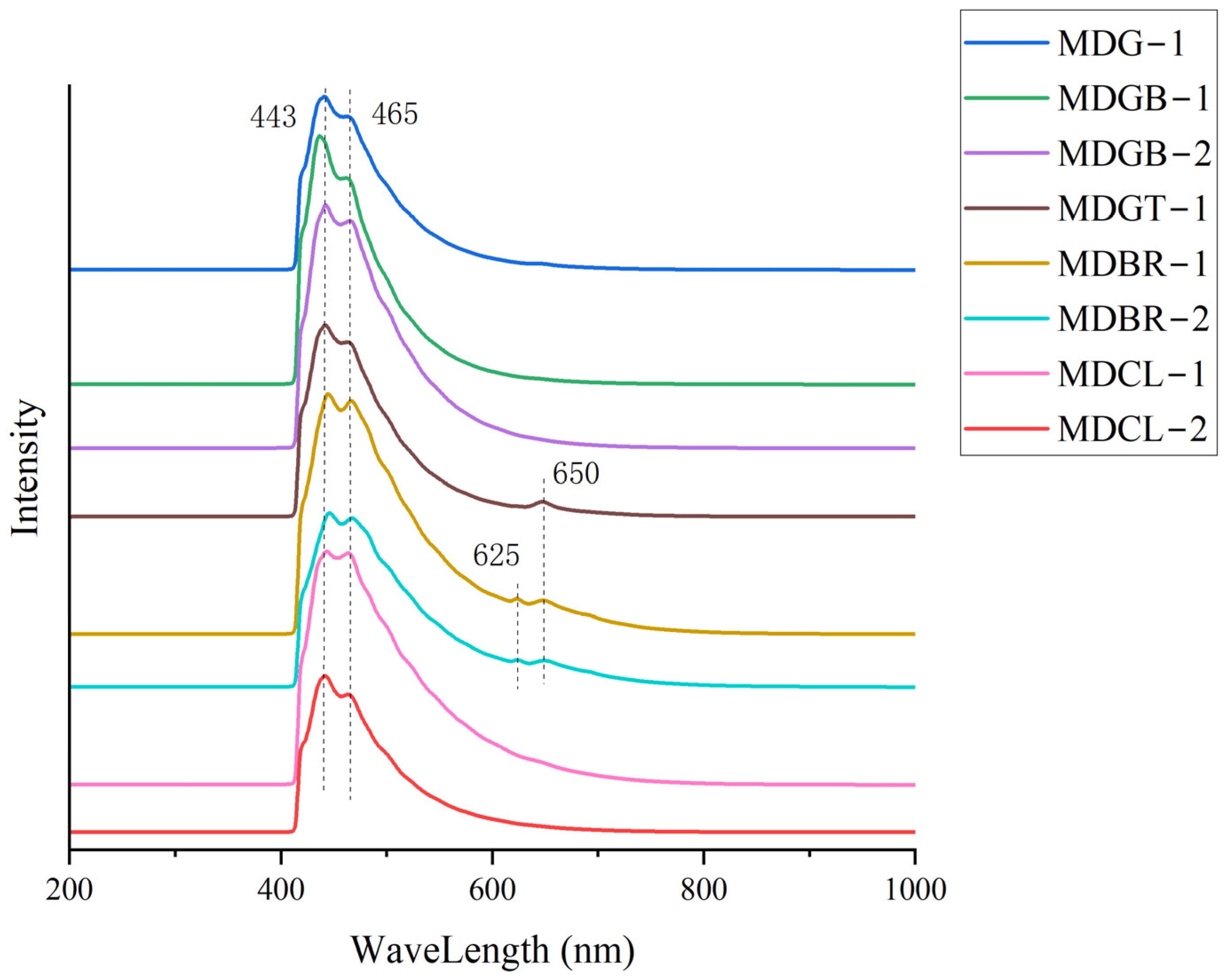
After annealing,
photoluminescence (PL) spectra of CdZnTe (CZT) films often exhibit significant changes that reflect the underlying modifications in the material’s
defect structure,
carrier recombination dynamics, and
crystal quality. These spectral changes are closely related to the processes of
defect passivation,
redistribution, and
annihilation that occur during thermal treatment. The key photoluminescence spectral changes and their relationship to defect behavior are detailed below.
## Changes in Photoluminescence Spectra After Annealing
## 1. Increase in PL Intensity
One of the most commonly observed changes after annealing is a
substantial increase in the overall PL intensity. This enhancement is primarily attributed to:
*
Defect passivation: Annealing can reduce non-radiative recombination centers—such as vacancy-related defects (e.g., Te vacancies V\_Te, Cd vacancies V\_Cd), antisites, and dislocations—by passivating or annihilating them. Passivation often occurs via atomic rearrangements or through the incorporation of excess atoms (e.g., Te atmosphere annealing) that neutralize dangling bonds or vacancy sites.
*
Improved crystal quality: The reduction of structural defects improves carrier recombination efficiency, favoring
radiative recombination over non-radiative pathways. This leads to stronger PL signals.
The increased PL intensity is a strong indicator of
enhanced optical quality and reduced defect-related recombination losses in the CZT film.
## 2. Narrowing of PL Peaks
Annealing often causes the
full width at half maximum (FWHM) of the PL emission peaks to
narrow. This narrowing reflects:
*
Reduced disorder and compositional fluctuations: Thermal treatment facilitates atomic diffusion and homogenization, leading to more uniform local composition and fewer localized states caused by alloy disorder or strain fluctuations.
*
Lower defect density: A decrease in defect states reduces spectral broadening that originates from inhomogeneous non-radiative centers and localized trap states.
Narrower PL peaks signify better
crystal uniformity and
fewer deep-level traps influencing carrier recombination.
## 3. Shift in PL Peak Position
Annealing can induce
shifts in the peak positions of the PL spectra, typically seen as:
*
Blue shift: A slight increase in peak energy can occur due to the
reduction of defect-induced band tail states and strain relaxation, leading to a more defined bandgap energy.
*
Red shift: In some cases, a red shift may occur if annealing causes
compositional changes, such as Zn diffusion altering the local bandgap, or if new radiative recombination centers related to shallow defects form.
These shifts in emission energy are sensitive indicators of the
local band structure changes induced by defect redistribution and lattice relaxation during annealing.
## 4. Emergence or Suppression of Defect-Related Emission Bands
Annealing often affects the relative intensity and presence of specific
defect-related PL bands:
*
Suppression of deep-level emission bands: Emission bands associated with
deep defects, such as those caused by vacancy complexes or antisite defects, typically decrease after annealing, indicating effective
passivation or annihilation of these centers.
*
Appearance of shallow-level emission: Sometimes annealing can enhance shallow donor-acceptor pair recombination bands, which correspond to
more benign defects or dopants that contribute to radiative recombination without significant carrier trapping.
These changes reflect the
redistribution and transformation of defect states, where harmful deep traps diminish and radiative centers become dominant.
## Relationship Between PL Changes and Defect Passivation or Redistribution
## Defect Passivation
Annealing promotes
atomic mobility, allowing atoms such as Cd or Te to migrate and
fill vacancy sites, effectively
passivating dangling bonds and reducing mid-gap trap states. For example:
* In a
Te-rich atmosphere, excess Te atoms can fill Cd vacancies (V\_Cd) or bond to dangling bonds associated with Te vacancies (V\_Te), leading to reduced non-radiative recombination.
* This passivation is directly linked to the increase in PL intensity and reduction in defect-related emission bands, indicating fewer recombination centers that act as traps or recombination sinks.
## Defect Redistribution
Thermal energy during annealing also causes
diffusion and rearrangement of defects:
* Dislocations and vacancy clusters can
recombine or migrate to grain boundaries or surfaces, reducing their density in the bulk.
* Dopants or impurities may redistribute, modifying shallow donor or acceptor levels that affect radiative recombination.
* Redistribution of Zn and Cd atoms can also homogenize alloy composition, reducing bandgap fluctuations and related localized states.
This redistribution results in the
narrowing of PL peaks and shifts in peak positions, signaling more uniform material properties and fewer localized states.
## Summary
In essence, annealing-induced changes in the photoluminescence spectra of CZT films—such as increased PL intensity, peak narrowing, peak shifts, and changes in defect-related emission bands—are direct manifestations of
defect passivation and
redistribution processes. These changes collectively indicate improved material quality with fewer non-radiative recombination centers and enhanced radiative recombination efficiency. Such improvements are crucial for the performance of CZT films in optoelectronic devices, including radiation detectors and photodetectors.
CdZnTe Association (CdZnTe.com)
https://www.cdznte.com/blog/what-photoluminescence-spectral-changes-occur-in-czt-films-after-annealing-and-how-do-these-relate-to-defect-passivation-or-redistribution.html